Forrest Hall
When Forrest Hall opened in the mid-1950s, it was meant to be more than just another classroom building. It was designed as a purpose-built home for the Department of Military Science and Tactics, the Reserve Officers’ Training Corps (ROTC) program at Middle Tennessee State College. The building gave visible form to the college’s growing investment in military training and leadership on campus.
The ROTC program had been added to the college in 1950 “in cooperation with the federal government and the state board of education,” with the stated goals of developing leadership, imparting specialized skills, and offering commissions as second lieutenants in the Army reserves and, for a few, in the Regular Army. At first, the department operated in “less than adequate quarters” on the first floor of the Alumni Memorial Gymnasium. By the fall quarter of 1954, however, the State Board of Education accepted from the contractor “a splendid building wherein the Department of Military Science and Tactics is housed today.” Located in the northeastern part of the instructional area of campus, the new ROTC building quickly drew praise. Inspecting officers from Third Army Headquarters in Atlanta repeatedly remarked that this was “the best for its intended purposes of any in the Third Army Area,” and it was described as one of the finest ROTC facilities in Tennessee. The building provided offices, classrooms, storage, and drill space suited to a growing program that aimed to train college students as future Army officers.
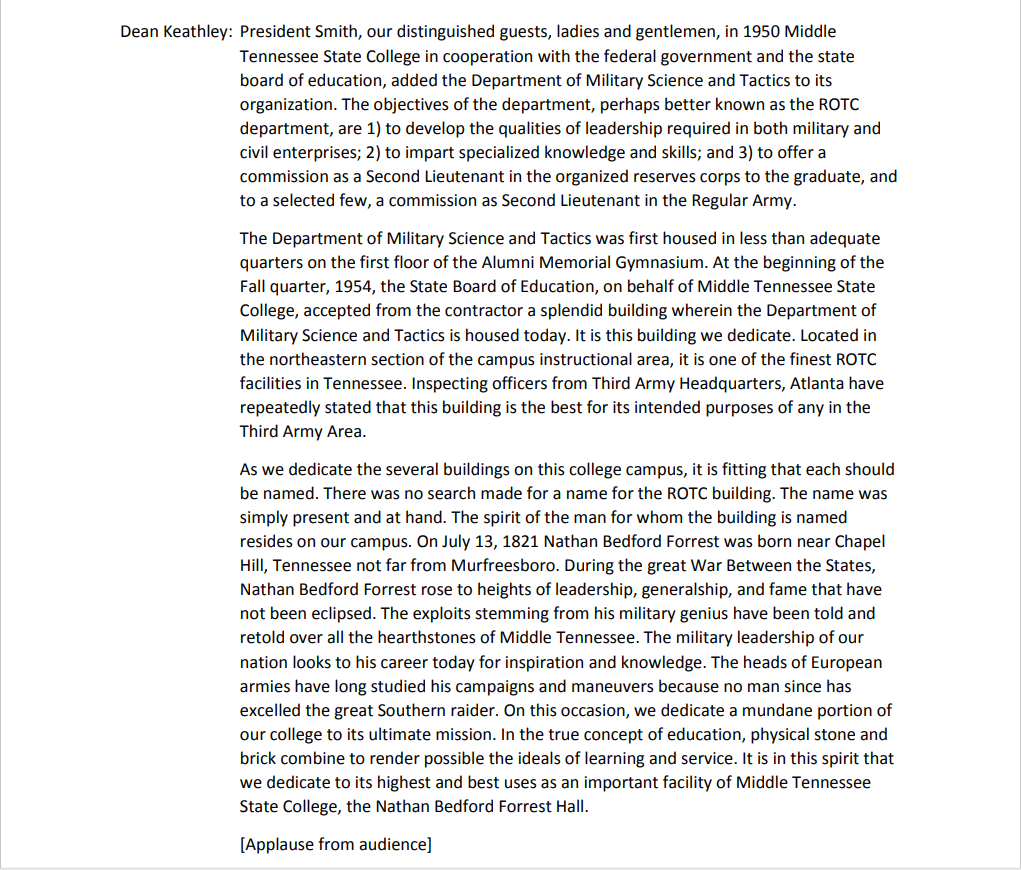
At the formal dedication, Dean Keathley explained how the building fit into the college’s broader mission. He reminded the audience that as the campus expanded, it was “fitting that each [building] should be named.” In the case of the ROTC building, he said, “there was no search made for a name… The name was simply present and at hand.” He linked the building to Nathan Bedford Forrest, born near Chapel Hill, Tennessee, whose Civil War campaigns had long been celebrated by military leaders and studied by European armies. In closing, he stressed that “physical stone and brick combine to render possible the ideals of learning and service,” and dedicated the Nathan Bedford Forrest Hall “to its highest and best uses as an important facility of Middle Tennessee State College.”
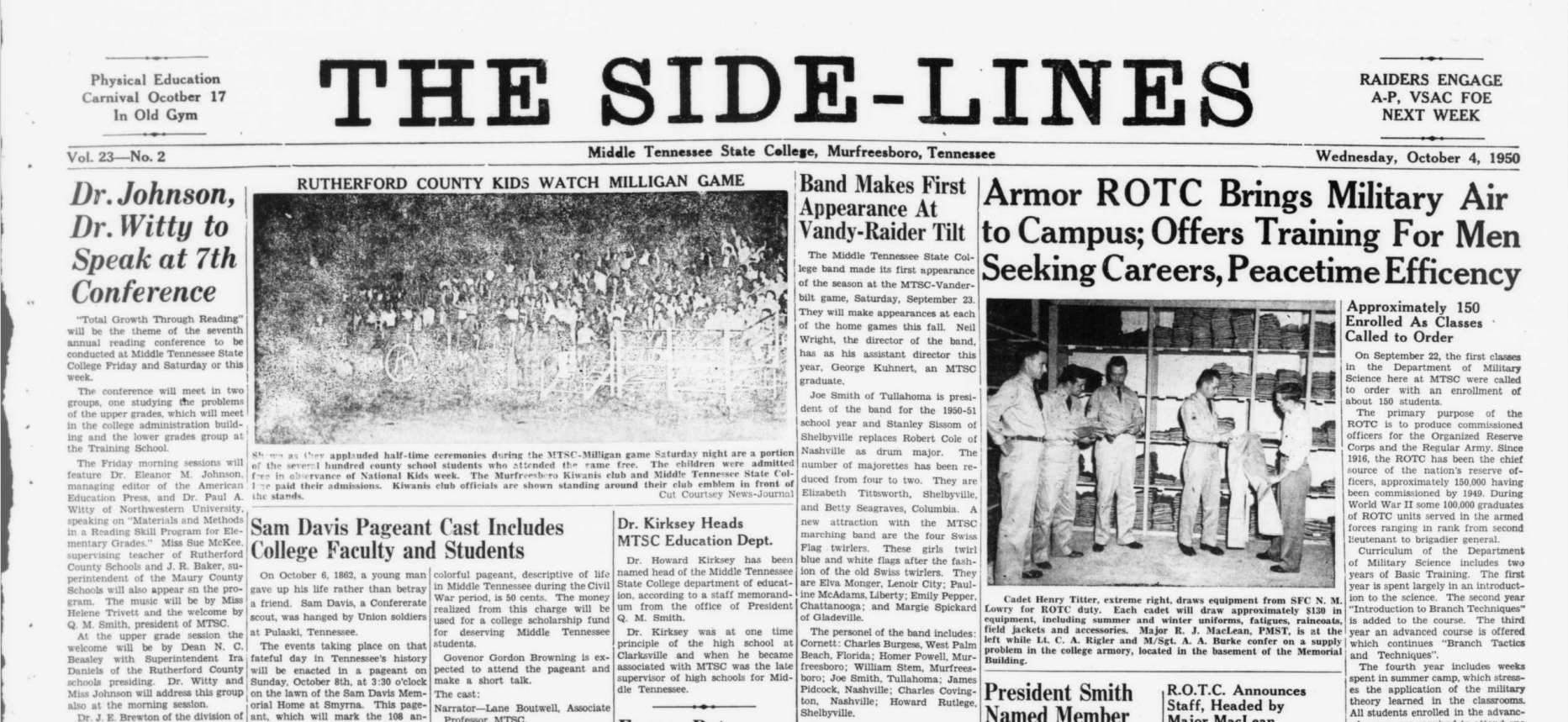
Daily life in and around Forrest Hall revolved around training cadets. Articles on the Armor ROTC unit described how students drew equipment—uniforms, fatigues, raincoats, field jackets, and accessories—for use in their courses and drills. Cadets underwent physical examinations to prove they were fit for general military service and had to meet age limits to enroll in the program. College officials noted that participation in ROTC might improve a student’s chances of deferment if drafted, and that ROTC training would help them become more effective both in military roles and in peacetime occupations. Forrest Hall thus functioned not only as a classroom space but also as an institutional gateway linking campus life to national defense.
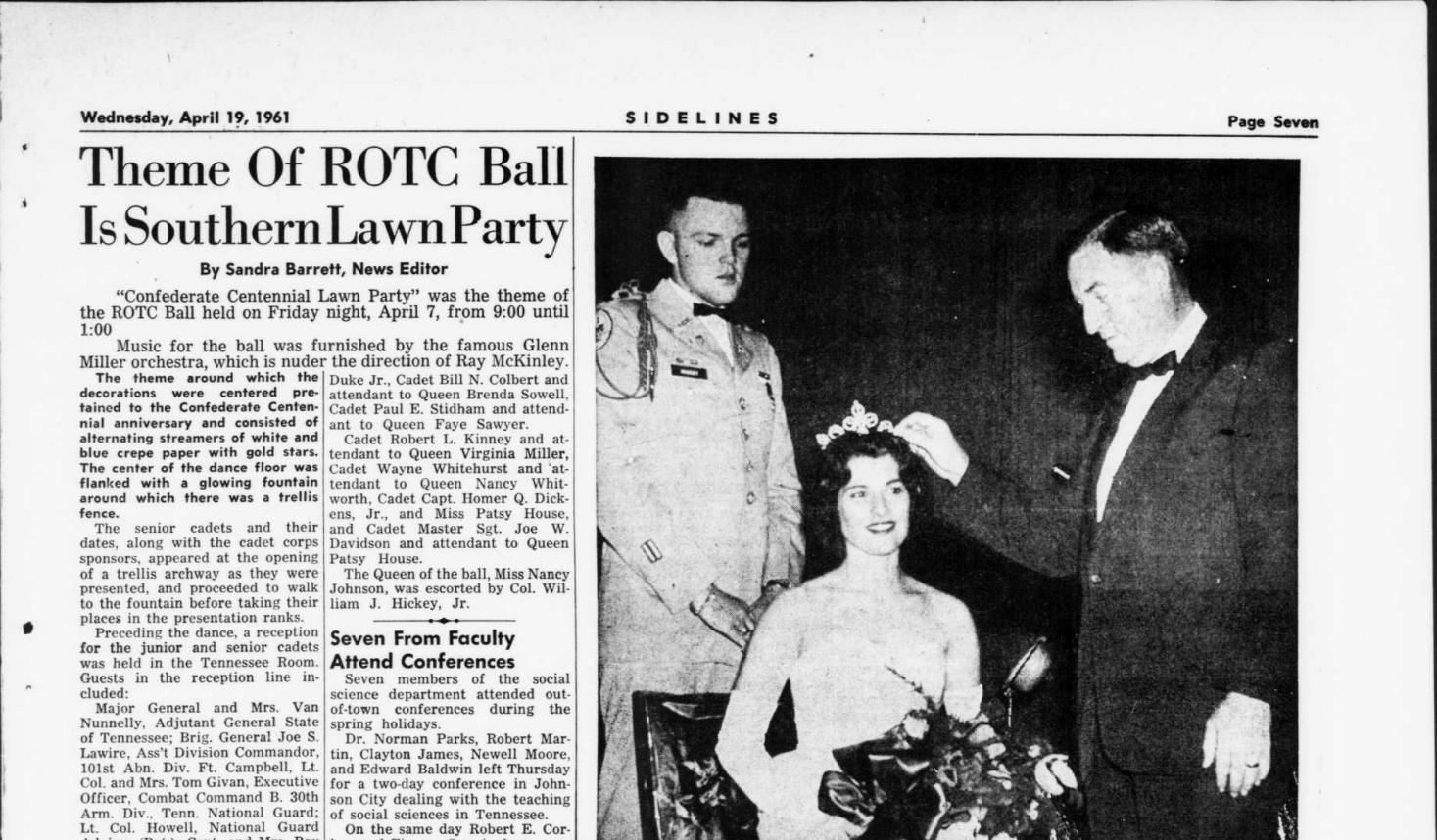
The building also served as a social and ceremonial center for the ROTC community. In April 1961, Sidelines reported on the ROTC Ball, which used the theme “Confederate Centennial Lawn Party.” The event, held from 9:00 p.m. to 1:00 a.m., featured music by the Glenn Miller Orchestra and decorations built around the Civil War centennial, including alternating white and blue streamers with gold stars and a glowing fountain flanked by a trellis fence. Senior cadets, their dates, and sponsors processed through a trellis archway to the fountain before taking their places for presentation, while a reception for junior and senior cadets was held beforehand in the Tennessee Room, attended by state military officials, National Guard officers, and the college president. These scenes show Forrest Hall and the ROTC program at the center of a campus culture that linked military tradition and social life, often framed through celebrations of the Confederate past.
Photographs and campus coverage from the 1950s and 1960s regularly highlighted cadets drilling, drawing equipment, and gathering for ceremonies associated with the ROTC unit. Together, these sources present Forrest Hall as a physical anchor for military education on campus—a place where leadership training, campus pride, and regional historical memory converged long before the building’s name became a subject of controversy on its own.